
What is Onboarding?
What Is Onboarding?
Onboarding is the process through which organizations equip new employees with the knowledge and skills they need to succeed at their jobs. Unlike new employee orientation, which is usually an isolated, single-day event, the employee onboarding process should begin with the organization’s first contact with a new hire and continue through the employee’s first year on the job. Onboarding is the very first talent development program that an employee will go through at any organization.
What Is the Onboarding Process for a New Employee?
Effective onboarding programs are essential for new employee training and development. While organizations may use different terminology or structures, onboarding should be tailored to the employee's role, responsibilities, and learning needs rather than delivered as a one-size-fits-all experience.
Some organizations divide their onboarding process into activities that take place in four areas:
Before the employee starts or pre-boarding
Welcoming the employee’s first day
Transitioning into the new role
Ongoing development with various checkpoints throughout an employee’s first 90 days until their first year on the job
While some organizations structure onboarding around time-based milestones, others organize onboarding around the learning employees need throughout their first year. These programs generally focus on:
Organizational onboarding— Employees learn the organization’s history and culture as well as procedures.
Social onboarding— Employees acclimate to their new team and its social dynamics.
Technical onboarding— Employees learn how to perform the tasks associated with their new job.
The Five Stages of Onboarding
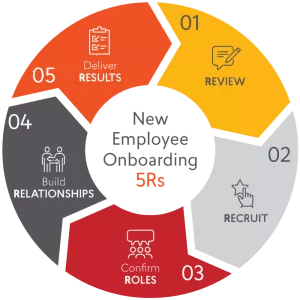
ATD’s 5R Model of Onboarding is a framework for creating a more complete and strategic onboarding experience. The model focuses on helping employees become engaged, productive, and connected over time. The five “Rs” are:
Review
Recruit for Retention
Role Clarity
Relationships
Results
Here’s a breakdown of each one:
Review
Organizations should first examine their onboarding process. This includes identifying strengths, weaknesses, and whether onboarding supports organizational goals. The idea is to make onboarding intentional and measurable rather than a disconnected series of presentations.
Recruit for Retention
This phase starts before the employee’s first day. Set realistic expectations, create a positive first impression, and build engagement early. Pre-boarding activities can improve retention and commitment.
Role Clarity
New hires need to understand not just what to do, but how their work contributes to the organization. Managers play a major role here by defining expectations, providing training, and clarifying responsibilities.
Relationships
Socialization is a key onboarding factor. Employees who form strong workplace relationships tend to adapt faster and feel more connected to the organization. Mentors, coaches, and regular manager check-ins are common strategies.
Results
The Results stage focuses on measuring whether onboarding is achieving its intended outcomes, including retention, productivity, time-to-proficiency, employee engagement, and satisfaction.
You can think of the 5Rs as moving from: planning → hiring → clarifying → connecting → performing.
Why Onboarding Matters
Onboarding is more important than ever. A recent study conducted by the Brandon Hall Group found that a “strong onboarding process improved new hire retention by 82 percent and productivity by more than 70 percent.” The cost of a bad onboarding process has never been higher. In fact, most new hires decide whether to stay in an organization within the first six months of their new job.
While administrative tasks such as benefits enrollment and paperwork remain important, successful onboarding programs also prioritize relationship-building, engagement, and employee development from day one.
Common Onboarding Challenges and Best Practices
Onboarding typically uses microlearning segments to continuously introduce new concepts, send reminders, and offer checkpoints for employees. Many organizations treat onboarding as an event rather than a process. The most successful programs view onboarding as a strategic experience that extends well beyond the first week. Common questions to think about when facing these challenges:
Are new hires becoming productive faster?
Are they staying longer?
Are they engaged?
Which parts of onboarding create the most value?
Here are some common challenges in onboarding and best practices to overcome them:
1. Information Overload
Many organizations try to deliver everything a new hire needs to know in the first few days. New employees are often overwhelmed by policies, systems, procedures, and introductions, making it difficult to retain critical information. Learning should be spaced over time rather than compressed into one day.
Best Practice: Start before day one. Often called preboarding, this involves engaging employees before their official start date. This helps reduce first-day anxiety and creates early engagement.
Examples:
Welcome messages from leaders
Access to introductory resources
Team introductions
Technology setup before arrival
2. Lack of Manager Involvement
HR frequently owns onboarding logistics, but managers sometimes assume their role ends after making the hire. This can leave new employees without clear guidance or support. Managers have the greatest influence on a new hire's engagement, productivity, and understanding of expectations, so their involvement in onboarding is critical.
Best Practice: Make managers active participants. Onboarding should be a partnership between HR, learning professionals, and managers.
Managers should:
Set expectations
Schedule regular check-ins
Provide coaching and feedback
Help new hires navigate the organization
3. Unclear Expectations
New hires may not fully understand what success looks like, how performance will be measured, what priorities they should focus on first, or how their work contributes to organizational goals. Without clear expectations, employees may feel overwhelmed or unsupported, creating frustration for both the individual and the team.
Best Practice: Focus on role clarity early. Many organizations use 30-, 60-, and 90-day plans to provide structure and transparency.
New hires should understand:
Their responsibilities
Key priorities
Performance expectations
Success metrics
4. Weak Social Connections
Remote and hybrid work environments can make it especially difficult for new employees to build relationships. Without strong connections, employees may feel isolated, less engaged, and less likely to stay with the organization. Creating social connections can be as simple as reserving a few minutes to check in with an employee in a new role, but it goes a long way in creating a psychologically safe workplace.
Best Practice: Intentionally build relationships. Strong onboarding programs don't leave networking to chance.
Try these methods:
Assigning onboarding buddies
Creating mentoring opportunities
Scheduling stakeholder meetings
Facilitating peer connections
5. Viewing Onboarding as a One-Day Orientation
Organizations often focus heavily on paperwork, compliance training, and administrative tasks while neglecting long-term integration and development. Treating onboarding as a one-day event limits its impact on employee engagement, productivity, and retention.
Best Practice: Build onboarding journeys that can last several months, or even up to a year for complex roles. Then measure what matters and connect onboarding activities to organizational outcomes:
New-hire retention
Time-to-productivity
Engagement scores
Manager satisfaction
New-hire feedback
Some onboarding activity suggestions are:
A welcome packet with company swag or a card from the team
A company buddy
Welcome lunch on the first day, if in-person, or a gift card to lunch if remote
Entry interview with loose goal setting
New hire happy hour
Scavenger hunt
A company mentor or mentoring program
Regular checkpoints set up for the first 90 days
One-on-ones with the manager (set up bi-weekly to monthly for the rest of the year)
Who Is Responsible for Onboarding?
Effective onboarding is a shared responsibility. While human resources professionals typically design and coordinate the onboarding strategy, successful onboarding requires support from managers, learning and development teams, IT, finance, and other stakeholders across the organization. If you work in any scope of talent management, onboarding may fall into your responsibility.
The direct manager and team are responsible for welcoming the new employee, helping them acclimate to the new role and organization, and answering the new hire’s questions about institutional knowledge.
When the entire organization welcomes a new hire, the new hire will feel more engaged and part of the community. By offering a warm welcome to the new employee, your organization is setting them up for a more productive experience within the role.
How Long Does Onboarding Take?
The most popular timeframe for an onboarding program is between 30 and 60 days, according to the Aberdeen group. However, about 25 percent of companies still offer a one-day orientation process. Anything less than a month can harm an organization’s retention rates.
Some organizations are extending their onboarding process from three months to the entire first year. By creating a yearlong program, you help ensure the new hire has a positive and productive experience with all their performance, social, and organizational needs being addressed.
Virtual Onboarding
For some organizations, virtual onboarding is not new, but for most companies, the COVID-19 pandemic increased remote work and has changed how onboarding is delivered.
Along with ensuring that new hires have the technology for a smooth remote work experience, it is vital that new-employee virtual onboarding creates a successful experience for both the employer and employee.
Virtual onboarding should follow the same long-term principles as in-person onboarding, beginning before day one and continuing throughout the employee's first year.
Although the new employee may not be physically in the office, there is a strong need for human connection, which can be difficult for employers to provide. Face-to-face video calls and other personal touches can help. One way many organizations do this is to provide a buddy system so employees outside of a new hire’s department can connect with the new hire early and often help them understand the workplace culture and norms.
An employee’s first day can be overwhelming, so the virtual onboarding process should include some downtime for the new employee to reflect on the new information they have received.
Frequently Asked Questions About Onboarding
What is onboarding?
Onboarding is the process through which organizations equip new employees with the knowledge and skills they need to succeed at their jobs.
How is onboarding different from orientation?
Orientation is usually an isolated, single-day event to introduce the employee to the company, team, and role. The onboarding process is longer and starts with the first contact an organization has with a new hire and will continue through the employee’s first year on the job.
What are the stages of the onboarding process?
According to ATD's 5R Model of Onboarding, organizations should focus on Review, Recruit for Retention, Role Clarity, Relationships, and Results. These elements help guide a comprehensive onboarding strategy that supports employee success over time.
Why is onboarding important?
Most new hires decide whether to stay with an organization within the first six months of their new job. In addition, a study conducted by the Brandon Hall Group found that a “strong onboarding process improved new hire retention by 82 percent and productivity by more than 70 percent.” An organization can’t grow if they’re too focused on filling roles and improving retention.
How long should onboarding last?
A good, dedicated onboarding process will begin with the first communication an organization has with a new employee and continue until that employee completes their first year with the company. Most onboarding processes follow a 30-60-90 rule with dedicated check-ins during the first 30, 60, and 90 days of employment. After this time, the frequency of onboarding activities may be reduced.
Related ATD Resources
ATD’s mission is to empower professionals to develop talent in the workplace, and developing talent starts with the onboarding process. Designing effective onboarding programs involves instructional design, training, evaluation, and other aspects of workplace learning. ATD curates the best content from the world’s leading experts in the field, providing resources to help HR/OD professionals improve their organization’s onboarding practices.
We look at talent development holistically and understand how onboarding fits into the entire employee life cycle, starting with recruiting and hiring to employee engagement and culture. Check out various ATD education courses and start your learning journey today.
For access to even more resources, including practical tools and templates, research, and insights, you’re invited to become an ATD member. Learn more.
For more information on onboarding, visit the following:

BLOGS
Talent Strategy & Management Topic Page
The latest on content on employee and organizational development. Start here!

NEWSLETTER
OD and Talent Management Newsletter
Insights and trends for improving organizationa's capability. Sign up today!

COURSES BY ROLE
Human Resources & Organizational Development Professionals
Discover courses for human resources and organizational development professionals, or TD professionals with HR/OD responsibilities. Explore courses!

GLOSSARY TERMS
Talent Development Glossary Terms
Learn about essential terms and need-to-know expressions for training and development professionals. Explore now!
Free Virtual Onboarding Essentials Checklist
Successfully onboarding new colleagues has never been more important than it is today. Regardless of whether your workforce is remote, in the office, or a combination of both, your organization should be modifying its approach to onboarding.