
What is Executive Coaching?
What is Executive Coaching?
To understand what an executive coach is, we first must define “coaching.” According to the International Coaching Federation (ICF), coaching is defined as a partnership with clients in a thought-provoking and creative process that inspires them to maximize their personal and professional potential. Coaching is a client-driven process that’s distinct from other service professions, such as counseling, mentoring, consulting, and training.
What Is an Executive Coach?
Coaching is probably one of the most—if not the most—individually tailored practices in talent development, as it involves a close and confidential relationship between the coach and the person being coached. In one-on-one meetings with senior managers or leaders within an organization (such as a director, vice president, president, or member of the C-suite), the executive coach provides a safe, structured, and trustworthy environment in which to offer support to the individual. The coach also helps the leader understand their current competencies, how they’re perceived by others, and how to identify and clarify current goals, as well as the appropriate action steps to reach them.
What Does an Executive Coach Do?
An executive coach is a professional partner who engages with senior-level leaders in a thought-provoking and creative process to maximize their personal and professional potential. Unlike general life coaching, executive leadership coaching focuses specifically on individuals in demanding leadership roles who are steering an organization. This typically includes senior leaders, C-suite executives, managers, and emerging leaders.
An executive coach helps their client with:
Unlocking potential: Helps leaders tap into previously unused sources of imagination and productivity
Strategic growth: Focuses on honing high-level leadership skills, self-awareness, and strategic thinking
Performance catalyst: Acts as a cornerstone for organizational effectiveness by improving the performance of its top decision makers
Types of Coaching
Executive coaches are not the only types of coaches in the professional world. Many managers now take classes to develop their coaching skills so they can help their employees improve their performance, earn promotions, and advance into leadership roles. Both internal and external coaches offer different levels of support:
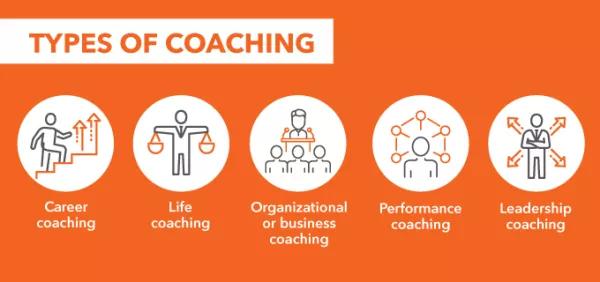
Career coaching – Provides support for employees looking to make a career transition, whether short- or long-term, including guidance on their professional development and job search. Career coaches may help with resume writing, job searches, online profiles, and job interviewing.
Life coaching – While not the most popular type of coaching within an organization, life coaches are still sometimes present internally. This specialty of coaching focuses on various aspects of life, including career, health and fitness, finances, relationships, and spiritual growth.
Organizational or business coaching – Provides business owners and entrepreneurs with support in identifying goals, creating strategies to obtain those goals, and boosting the overall performance of the organization
Performance coaching – Supports individuals within organizations who need to improve their work performance, often following performance appraisal results, regardless of level or job title
Leadership coaching – Provides coaching for those looking to grow and develop leadership skills, regardless of whether they are an individual contributor, manager, or senior manager
Coaching Versus Mentoring: What Coaching Is Not
Many people confuse coaching with counseling or mentoring. Coaching is different from these practices in several ways. Coaching does not offer therapeutic outcomes like counseling. Merriam-Webster defines counseling as “professional guidance of the individual by utilizing psychological methods, especially in collecting case history data, using various techniques of the personal interview, and testing interests and aptitudes.”
Counseling offers introspection and time looking at one’s past, whereas coaching is future-oriented.
Mentoring is a self-directed, mutually beneficial, long-term relationship between two individuals for career advancement, in which the mentor does most of the talking and offers advice. While coaching is a true partnership among equals, mentoring most typically consists of a more experienced person directly guiding the mentee through an experience that the mentor has already been through.
Coaching is a conversation focused on helping others (coachees or clients) move forward toward their goals, hopes, and curiosities—not exploring their past. For coaching to be helpful, it should be directly tied to what the client wants to accomplish, through a process that is directed by the coachee, where the coachee is empowered to uncover and develop their own path to achieving their goal and does the majority of the talking.
Because coaches handle personal and sensitive information, they should abide by ethical guidelines. Some professional organizations, such as ATD and ICF, have developed such guidelines and codes of conduct that apply to the practice of coaching. Included in those guidelines are honesty, fairness, lawfulness, compassion, respect, loyalty, and dependability.
What Are the Benefits of Executive Coaching?
The coaching industry is one of the fastest-growing sectors worldwide. The estimated global total revenue from coaching in 2019 was $2.849 billion, a 21% increase over the 2015 estimate (ICF 2020).
Coaching is growing in popularity because it works. According to the Institute for Professional Excellence in Coaching (iPEC), 99% of those coached were “satisfied or very satisfied,” and 96% said that “they’d repeat the process” (Hudson 2016). A third of all Fortune 500 companies include executive coaching as part of their standard leadership development for elite executives and talented up-and-comers (iPEC Coaching n.d.), and that figure is growing.
Most coaching dynamics will focus on an individual’s professional development and career coaching. The benefits of executive coaching include tailored strategic thinking for the organization, high-level leadership development, and performance coaching aligned with the company’s overarching goals.
Greiner, executive coach, expert, and author of The Executive Coaching Playbook: How to Launch, Run, and Grow Your Business, notes, “The core belief of executive coaching is that individuals are capable of change. It’s grounded in the observation that executive development is an ongoing journey needed to grow organizations and their own career path. Additionally, the client may need support in identifying any potential blind spots and using a clear method to improve themselves or their situation more rapidly and dramatically. Here’s where an executive coach comes in.”
How Does Executive Coaching Work? (Step-by-Step Process)
As outlined by Paul Fein, an organizational development consultant and certified life coach, the executive coaching process is based on seven key areas.
Empower the client by being supportive of driving the use of strengths and special skills. This builds on the self-reflective approach and on the motivation to achieve goals.
Help the client find solutions through in-depth insights and understanding of critical issues. This is promoting the discovery of new and different ways to address challenges.
Enable the client to gain insights into new technologies and consumer product trends. This is to drive free thinking that builds on flexibility and adaptability to changes.
Drive the client to handle team challenges while fostering open, authentic connections. This is to accelerate organizational performance improvements and successes.
Grow the client to maximize communication messages with clarity and value. This is to find ways to overcome personal weaknesses and enhance information flow.
Assist the client in obtaining and evaluating constructive feedback for development actions. This is to identify and deepen learning and growth opportunities.
Support the client to secure critical business performance progress and outcomes. This is to help drive the importance of holding others accountable.
Key Skills of a Successful Executive Coach
Because the coaching industry is largely unregulated, a proficient executive coach must possess a cross-disciplinary blend of verifiable expertise, such as:
Business Acumen – A deep understanding of organizational partnerships, political dynamics, and enterprise-wide perspectives. This often includes graduate training in management or experience in senior leadership roles.
Psychological Depth – Grounding in adult development, social psychology (biases and power dynamics), and leadership psychology to facilitate behavioral transformation and emotional intelligence. This may also include strategic thinking from both personal and organizational perspectives.
Coaching Mastery – Certification from reputable global organizations (such as the ICF, EMCC, or Marshall Goldsmith Stakeholder Centered Coaching) and a commitment to ongoing continuing education.
Ethical Mastery – Strict adherence to established ethical codes, maintaining clear communication and trust while prioritizing the “do no harm” principle.
Executive Coaching Models and Frameworks
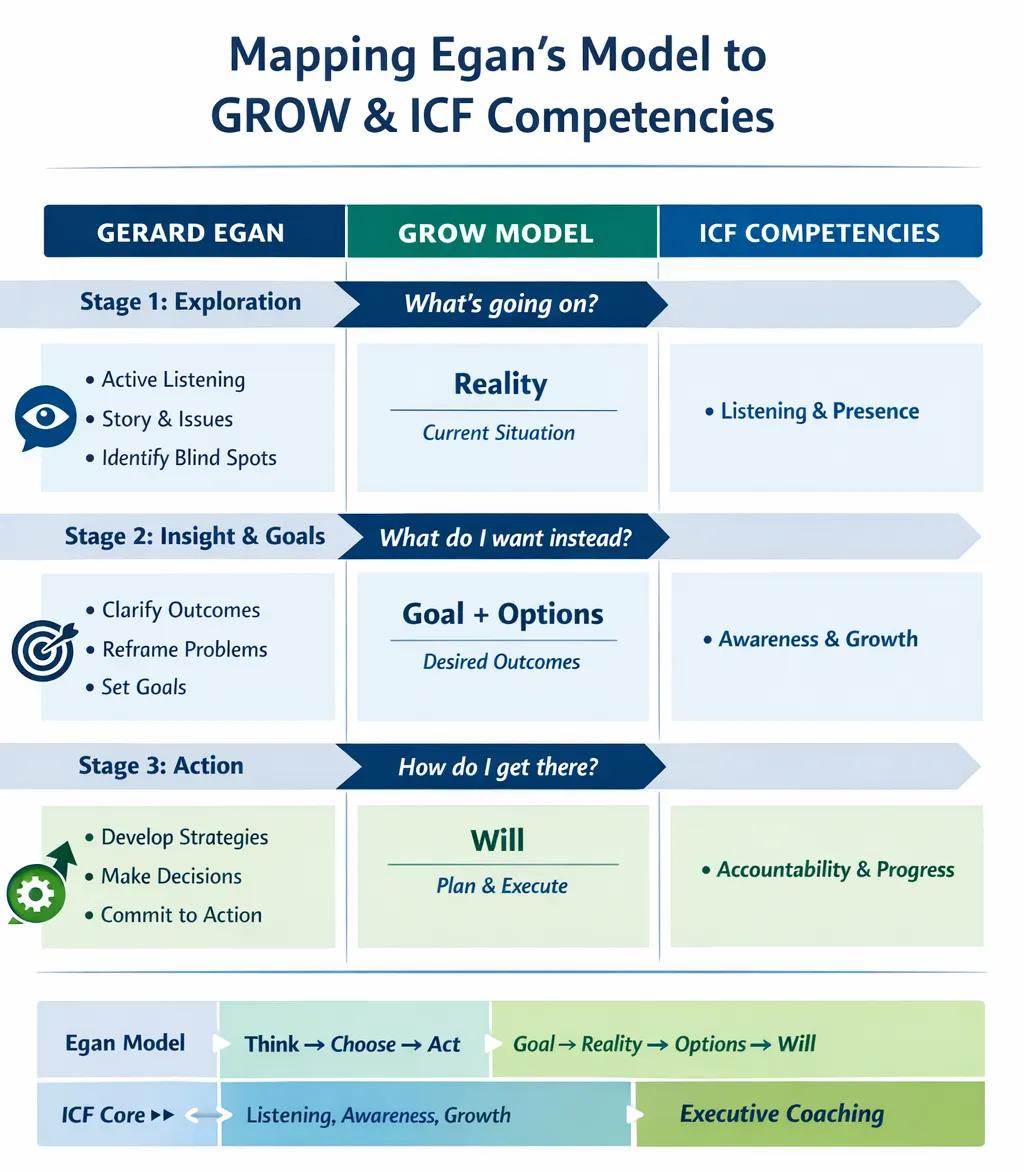
The following executive leadership coaching models share similar elements: discovering the client’s perspective and reality, setting goals or objectives, offering differing points of view or options, and then choosing the best course of action to move ahead toward a desired state. This is rooted in a relationship built on trust and ensuring the client’s privacy while maintaining confidentiality.
The ATD Coach Model
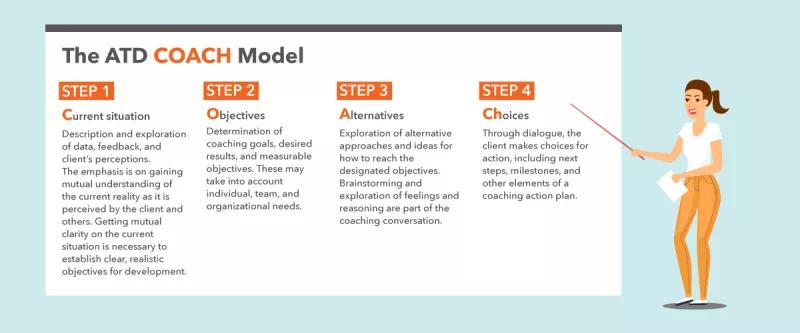
The GROW Model
While the ATD COACH model remains widely accepted, many coaches have used the GROW model since the 1980s in corporate settings.
GROW stands for goal, current reality, options (or obstacles), and will (or way forward).
The Egan Model
This is a framework developed by Gerard Egan, a psychologist and professor emeritus at Loyola University Chicago, who became one of the most influential voices in counseling, communication, and organization development. He developed a structured model for helping people think through problems and act. It’s widely used in counseling and life coaching, but it can be transferable to many helping roles, including managers and leadership coaching.
The centerpiece is Egan’s three-stage model:
Stage 1: Current Picture (What’s going on?)
Gaining an understanding, tuning in, and active listening
Reflect and respond
Stage 2: Preferred Picture (What’s needed?)
Clarification of concerns and checking understanding
Probing and summarizing
Stage 3: Forward Picture (What’s needed?)
Testing reality, focusing on changes, and understanding challenges
Generate strategies and choose best-fit actions
This is often described as a problem-management and opportunity-development approach that doesn’t just fix issues but focuses on helping people create better futures. Egan’s work is essentially a bridge between counseling psychology and practical leadership conversations.
For executive coaching, it provides a clear conversation arc, a repeatable way to move from problem to insight to action, and a balance of empathy and accountability. Egan’s approach isn’t limited to professional coaches. It’s designed so managers can use it in everyday conversations, making it highly relevant for leadership development programs, manager coaching capability, and performance conversations.
Compare Coaching Models
How to Pick the Right Coach
Selecting the right executive coach requires a systematic evaluation to ensure a strong ROI. The organization or the leader should drive this process, not the coach.
1. The Vetting Phase
Evaluate candidates based on a scoring system that weighs their documentable experience in the four core areas: business, psychology, coaching, and ethics. Coaches should have a background that aligns with the specific industry sectors or functional challenges the leader faces.
2. The Interview Process
Conduct a 45- to 60-minute interview to assess “intangible” qualities. Key areas to explore include:
Problem-Solving: How do they apply their expertise to real-world scenarios?
Resilience: How do they handle obstacles and their own professional frustrations?
Insight: Do they understand their own biases and how those might affect the coaching relationship?
Interpersonal Fit: After the session, reflect on the “feel” of the conversation—did they seem like a collaborative problem-solver or a detached expert?
A professional, certified coach is always the best option, but it’s important to verify their skills. Always seek feedback from past clients to gain insight into the coach’s track record of effectiveness and ability to drive lasting success.
BLOGS
Coaching Topic Page
Explore coaching articles for all levels. Find strategies, insights, and best practices to elevate your expertise. Start here!

NEWSLETTER
OD & Talent Management Newsletter
Insights and trends for improving an oganization's capability. Sign up today!

COURSES BY ROLE
Coaches
Check out our recommended certificate programs for coaches, including core, specialist, and advanced programs. Explore courses!
EVENTS
ATD Events
Talent development professionals come together to give you conference experiences that are diverse in education, solutions, and opportunities. Learn more!

GLOSSARY TERMS
Talent Development Glossary Terms
Learn about essential terms and need-to-know expressions for training and development professionals. Explore now!
Free E-Book: What Is Executive Coaching?
Discover what an executive coach is, the requirements and skillsets needed to be a good executive coach, and a template of the overview of the coaching process.
How Can ATD Help With Executive Coaching?
ATD has long understood the need for coaching in the workforce. We know coaching is a powerful development tool that leads to positive change and improved performance across careers and the organization as a whole. That is why ATD curates the best content from some of the most experienced coaches to develop coaching content and offerings.
Talent development professionals and managers alike use ATD to improve their ability to develop internal coaching programs, learn about coaching practices and competencies, and gain strategies to amplify their coaching abilities.
For access to more resources, including practical tools and templates, research, and insights, become an ATD member. For more ATD resources about executive coaching, visit the following: